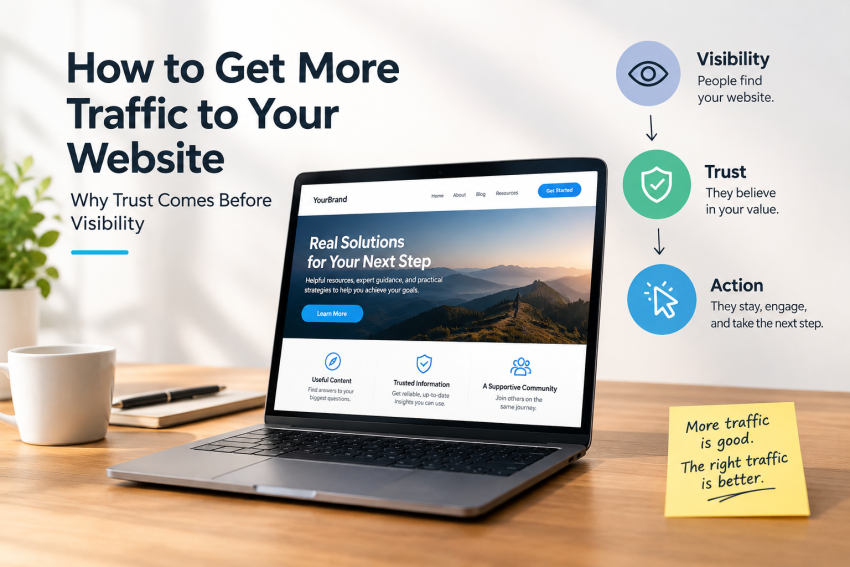
Most websites do not have a traffic problem.
They have a trust problem.
You can rank in search results. You can post on social media. You can run ads. You can publish dozens of articles.
But if visitors do not immediately understand why they should click, stay, or take the next step, more visibility will not solve the underlying problem.
The real question is different:
Why would the right person trust your website enough to continue?
That question changes how you approach website traffic.
Traffic Is Not Just About Being Seen
Getting someone to notice your website is only the first stage.
The visitor still has to make several decisions:
- Is this relevant to me?
- Does this answer my question?
- Can I trust this information?
- Is this worth my time?
- What should I do next?
Every additional moment of uncertainty creates friction.
This is why two websites can receive similar levels of exposure but produce very different results.
One gives visitors a clear reason to continue.
The other makes them work to figure out what it offers.
Visibility creates an opportunity. Trust determines what happens next.
Your Visitor’s Brain Is Evaluating Effort and Reward
People do not process every website element equally.
The brain quickly evaluates whether something appears relevant enough to deserve attention.
When a page has a clear message, recognizable problem, specific benefit, and obvious next step, the visitor has less mental work to do.
That matters because cognitive effort influences behavior.
If someone has to decode a vague headline, search through unnecessary information, or figure out whether the page applies to their situation, attention can disappear before the value becomes clear.
This creates an important website-traffic principle:
Make the value easier to understand than the decision to leave.
Generic Content Makes Traffic Harder to Convert
Consider these two headlines:
“Welcome to Our Digital Marketing Agency”
versus:
“How to Get Your First 1,000 Website Visitors Without Relying on Paid Ads”
The second headline gives the visitor much more information.
It identifies an outcome.
It establishes a problem.
It creates a reason to continue.
It also helps the right audience recognize itself.
This does not mean every headline should promise a specific numerical result. It means the visitor should quickly understand what the page is about and why it may matter to them.
That clarity can improve the quality of the traffic you attract.
Stop Creating Content for Keywords Alone
Keywords are useful.
But keywords are not the entire reason someone searches.
Behind a search query is an objective.
Someone searching for:
“website traffic”
could be looking for definitions, strategies, SEO advice, analytics information, advertising methods, or ways to increase sales.
Those are different intentions.
A strong content strategy begins by asking:
What is this person actually trying to accomplish?
Then the page should help them accomplish it.
This creates a closer connection between search intent and content.
And that connection matters.
When your content matches the visitor’s objective, relevance becomes easier to recognize.
Build Content Around Problems People Already Want Solved
A useful website does not need to answer everything.
It needs to answer the right questions exceptionally well.
Start with the problems your audience repeatedly encounters.
Then create content around those problems.
For example, a website focused on increasing online traffic could create resources about:
- How to increase organic traffic
- How to improve website click-through rates
- How to create SEO content
- How to get traffic from social media
- How to turn visitors into email subscribers
- Why website traffic is increasing without increasing sales
- How to identify high-intent website visitors
Each topic addresses a specific concern.
Over time, these pages can create a deeper body of useful information around the same problem.
That is more strategic than publishing unrelated articles simply because they contain popular keywords.
Trust Begins Before the Visitor Reaches Your Website
One overlooked part of website traffic is the experience before the click.
Your search result, social post, video, email, or advertisement creates an expectation.
Then your website either confirms that expectation or breaks it.
If your headline promises one thing and the page delivers something else, trust declines.
If your social post makes a specific claim but the linked page is vague, the visitor has another reason to leave.
The transition should feel consistent.
The promise that earns the click should connect directly to the experience that follows it.
That principle applies across search engines, social platforms, email, and paid advertising.
Make the First Few Seconds Count
A visitor should not need to study your homepage to understand what you do.
Your opening section should answer three basic questions:
What is this?
Who is it for?
Why should I care?
You can then provide supporting information.
But clarity comes first.
This is especially important for visitors arriving from search engines or social media because they may have no previous relationship with your brand.
They are evaluating you from a cold start.
Give them enough information to make the next decision confidently.
More Traffic Is Not Always the Immediate Answer
Suppose 10,000 people visit a website.
If most leave because the page is unclear, increasing that number to 20,000 does not address the fundamental issue.
It simply creates more opportunities for the same problem to occur.
That is why traffic should be evaluated alongside behavior.
Look at metrics such as:
- Engagement
- Time spent on important pages
- Click-through rates
- Conversion rates
- Email signups
- Returning visitors
- Traffic sources
- Pages that attract visitors but fail to move them forward
The goal is not simply to increase sessions.
The goal is to understand whether the traffic is relevant, engaged, and progressing toward a meaningful action.
Turn One Visitor Into More Than One Opportunity
A visitor who leaves without remembering your brand may never return.
A visitor who finds something genuinely useful may subscribe, bookmark the page, share it, or return later.
That changes the economics of traffic.
Instead of constantly asking:
“How do I get another visitor?”
you begin asking:
“How do I create enough value that this visitor has a reason to come back?”
Email newsletters, useful resources, calculators, checklists, tutorials, and related content can all support that goal.
The specific mechanism matters less than the principle:
Give visitors a reason to continue the relationship.
A Simple Framework for Building Trust-Based Traffic
Use this five-part framework when creating or improving a traffic strategy.
1. Identify the Problem
Find the problem your audience already wants solved.
Do not begin with what you want to publish.
Begin with what they need.
2. Identify the Intent
Determine what they are actually trying to accomplish.
Research?
Compare?
Learn?
Buy?
Fix something?
The answer affects the content you should create.
3. Create a Specific Promise
Tell visitors what they can expect from the page.
Make the promise clear and relevant.
Avoid vague claims.
4. Deliver the Expected Value
The page should fulfill the expectation created by the headline, search result, social post, or advertisement.
This is where trust is earned.
5. Give Them a Logical Next Step
Once the visitor receives value, make the next action obvious.
That could be reading another article, joining an email list, using a tool, requesting information, or exploring a related resource.
Do not force the next step.
Make it useful.
The Bigger Shift
Website traffic is often treated as a numbers game.
More visitors.
More clicks.
More impressions.
More pageviews.
But the more important question is what happens after attention arrives.
A website that people understand is easier to trust.
A website that consistently solves relevant problems has more opportunities to earn repeat attention.
And a website that earns trust does not have to depend entirely on constantly finding new people.
So before investing more effort into getting your website in front of more people, examine the experience those people receive when they arrive.
Ask:
Is the value obvious?
Does the page match their intent?
Does the content reduce uncertainty?
Does the visitor know what to do next?
If the answer is no, more traffic may not be the first thing you need.
Build the reason to trust first. Then build the reach.
If you want, you can generate additional formats from this same insight, including a social post, email, YouTube script, TikTok script, lead magnet, or landing page.