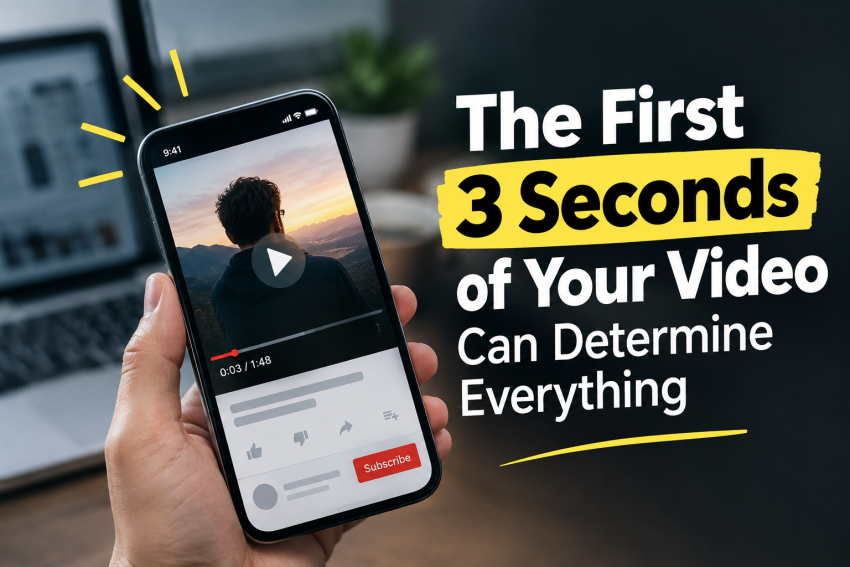
Most videos do not lose viewers because the content is bad.
They lose viewers before the content even begins.
That is the part many marketers miss.
You can have valuable information, excellent production quality, strong editing, and a compelling offer. But if the opening does not give someone a reason to keep watching, they may never reach the part that matters.
The first three seconds are not an introduction.
They are a decision point.
And understanding what happens during those first few seconds can completely change how you approach video marketing.
Why People Leave Before Your Message Starts
Every time someone encounters a video, their brain has to decide whether the information deserves attention.
There is no unlimited supply of attention.
The viewer is surrounded by competing signals, notifications, posts, messages, advertisements, conversations, and other videos.
Your video is competing against all of them.
That means your opening has one immediate job:
Give the viewer a reason to care about what happens next.
A generic introduction often fails because it asks for attention before providing a reason to give it.
“Hey everyone, welcome back.”
“Today we’re going to talk about…”
“In this video, I’m going to show you…”
None of these statements necessarily create urgency, curiosity, or relevance.
They delay the information the viewer actually came to find.
And that delay can be costly.
The Brain Is Constantly Looking for What Matters
Attention is not passive.
The brain continuously evaluates incoming information for relevance, novelty, and potential importance.
This is one reason unexpected information can capture attention.
When something violates an expectation, the brain has a reason to investigate it.
That principle matters enormously in video marketing.
If your opening sounds exactly like hundreds of other videos, there may be little reason for the viewer to devote additional attention to it.
But when the opening presents a meaningful surprise, a specific problem, or an unanswered question, the viewer has something to process.
That creates an information gap.
And information gaps can keep people watching because the brain wants to resolve uncertainty.
This gives marketers an important distinction:
A hook should not merely be attention-grabbing. It should make continued attention feel worthwhile.
Stop Treating the Hook Like an Introduction
One of the most common video marketing mistakes is starting with information about the creator instead of information about the viewer.
The viewer usually does not need your background first.
They need a reason to believe the next few seconds will be useful.
Consider the difference.
Weak:
“Hi, I’m Sarah, and I’ve been helping businesses with video marketing for years.”
Stronger:
“Your video may be losing viewers before they hear your best idea.”
The second opening immediately creates a problem.
It also creates a question:
Why are viewers leaving?
That question gives the viewer a reason to continue.
The introduction can come later.
The value proposition comes first.
The Information Gap Is More Powerful Than More Information
A common assumption is that good educational content should explain everything immediately.
That sounds logical.
But it can create a retention problem.
If the viewer already knows exactly where the video is going, there may be little reason to keep watching.
Curiosity changes that.
For example:
“Most businesses think their video problem is poor editing. It usually starts somewhere much earlier.”
Now the viewer has an unanswered question.
What starts the problem?
Why is editing not the real issue?
What happens earlier?
The video has created a reason to continue.
This does not mean hiding information or manipulating viewers.
It means structuring information so that each section creates a natural reason to discover the next one.
That is the difference between dumping information and designing a viewing experience.
A Strong Hook Usually Contains One of Three Things
There are many ways to create an effective opening, but three principles are particularly useful.
1. A Specific Problem
Tell the viewer something is going wrong.
But make it specific.
Instead of:
“Video marketing is difficult.”
Try:
“Your videos may be getting views without producing customers because the opening attracts the wrong kind of attention.”
The second statement creates a more precise problem.
The viewer can immediately ask:
“Is that happening to me?”
That question creates relevance.
2. An Unexpected Truth
Challenge an assumption the audience already has.
For example:
“Better video quality does not automatically create better video performance.”
That statement creates tension between what the viewer may believe and what you are about to explain.
The viewer now has a reason to investigate.
3. An Unresolved Question
Ask a question that matters to the audience.
For example:
“What makes someone stop scrolling when they have thousands of other videos available?”
The question itself becomes the beginning of the content.
But there is an important condition.
The question must be relevant.
Random curiosity may generate attention, but attention without relevance rarely produces meaningful marketing results.
Your Hook Should Make a Promise
A strong opening communicates an implicit promise:
Keep watching, and you will understand something that matters to you.
That promise can involve a solution, explanation, discovery, correction, or new perspective.
The viewer does not necessarily need to know the entire answer.
They need to understand why finding the answer is worth their time.
This is where many marketers make another mistake.
They try to make the hook dramatic instead of useful.
Extreme claims can generate clicks.
But if the content does not deliver on the expectation created by the opening, trust suffers.
The objective is not maximum curiosity at any cost.
The objective is qualified curiosity.
You want the right person to think:
“I need to know this.”
Retention Starts Before the Main Content
Think about your video as a sequence of decisions.
First:
Should I stop?
Then:
Should I keep watching?
Then:
Is this actually useful?
Then:
Do I trust this person?
Then:
Should I take action?
The first three seconds influence the earliest decision.
That means improving retention cannot begin halfway through the video.
It begins with the first sentence, first visual, first claim, and first unresolved question.
If the opening fails, the rest of the video may never get its opportunity.
How to Build a Better Three-Second Opening
Before recording, answer four questions.
What problem does this video solve?
Be specific.
“Marketing” is broad.
“Why your short-form videos lose viewers immediately” is specific.
Who needs this information?
A strong hook speaks to a particular audience.
The more clearly the viewer recognizes themselves, the more relevant the message becomes.
What assumption can you challenge?
Find the belief that may be preventing the viewer from seeing the real problem.
This is often where the most interesting opening comes from.
What question should the viewer want answered?
Your opening should create a natural next question.
That question becomes the reason to continue watching.
A Simple Formula for Video Hooks
A useful structure is:
Problem → Tension → Unanswered Question
For example:
“Your videos may not have an editing problem. They may have an opening problem. And the mistake happens before most viewers even reach your main point.”
Notice what happens.
The problem is introduced.
The assumption is challenged.
A question is created.
The viewer now has a reason to continue.
This structure can work across educational videos, product marketing, personal brands, advertisements, tutorials, and short-form content.
What to Do After the Hook
A strong hook cannot save weak content forever.
Once you have earned attention, deliver on the promise.
Move quickly into the substance.
Avoid unnecessary introductions.
Avoid repeating the hook several times.
Avoid delaying the answer simply to extend watch time.
Instead, create a progression.
Give the viewer one useful idea.
Then introduce the next question.
Answer it.
Then create the next logical point.
This creates a continuous viewing experience where each section earns the next.
The Biggest Shift: Stop Trying to Impress the Viewer
Video marketing often becomes too focused on production.
Better cameras.
Better lighting.
Better transitions.
Better graphics.
Better effects.
Those things can improve presentation.
But they do not replace relevance.
A perfectly produced video with a weak opening can still lose attention.
A simple video with a clear, relevant opening can earn the opportunity to be watched.
That does not mean production quality is irrelevant.
It means production quality should support the message rather than compensate for a weak message.
The viewer does not owe your video attention because you spent hours creating it.
The opening has to earn that attention.
The Three-Second Test
Before publishing your next video, remove everything except the first three seconds.
Watch the opening by itself.
Then ask:
- Is the problem immediately clear?
- Does the opening create curiosity?
- Is the information relevant to a specific viewer?
- Does it challenge an assumption?
- Is there a reason to discover what comes next?
- Does the rest of the video actually deliver on the opening?
If the answer is no, do not immediately redesign the entire video.
Rewrite the opening.
Sometimes the biggest improvement is not another hour of editing.
It is another sentence.
Final Takeaway
The first three seconds are not a minor part of your video.
They determine whether the viewer gets far enough to experience the rest of your message.
Attention is limited.
Relevance matters.
Curiosity creates forward momentum.
And the strongest openings do not simply demand attention. They give the viewer a reason to invest it.
So before you record your next video, do not begin by asking:
“What do I want to say?”
Ask:
“Why should the right person care within the first three seconds?”
That question changes the entire structure of your video.
And once you learn to build openings around relevance, tension, and unresolved questions, your content has a much stronger chance of earning the attention required for everything else to work.