Every retargeting campaign is built on the same quiet assumption: the more someone sees your brand, the more they trust it. Familiarity breeds comfort; comfort breeds conversion. That logic works for the first several exposures. Then something flips, and almost nobody notices the exact moment it happens.
Here’s the part most marketers miss. Repetition doesn’t build trust on its own. It builds recognition. Trust and recognition feel similar in a dashboard full of impressions and reach numbers, but they’re not the same thing, and the gap between them is where retargeting budgets quietly die.
Think about what’s actually happening on the other end of that ad. Someone looked at a product, got distracted, and left. They didn’t reject the offer. They just didn’t finish the thought. Your retargeting ad shows up to remind them. First exposure: mild relief, maybe even a little “oh right, I was looking at that.” Second exposure: still fine, borderline helpful. But by the fourth or fifth time the same face, the same product shot, the same “still thinking it over?” copy shows up in their feed, something changes in how their brain files you. You stop being a helpful nudge and start being a symptom. You become the thing that reminds them they haven’t decided yet, which is an uncomfortable feeling, and people don’t warm up to whatever causes discomfort. They start avoiding it.
This is the mechanism worth understanding: ad fatigue isn’t really about the ad going stale. It’s about the emotional tax the viewer pays every time they see it. Early exposures are free. There’s no cost to seeing something new or half-familiar. But repeated exposure to unresolved content charges interest. Each viewing reopens a small decision the person didn’t want to make yet, and reopening it costs a little bit of goodwill. Eventually the account runs negative. At that point, more frequency doesn’t create more familiarity. It creates resentment with your logo on it.
Platform metrics won’t tell you this directly. Frequency and CPM will look normal for a while, sometimes even good, right up until the moment engagement quietly falls off a cliff and cost per result creeps up without any obvious cause. Most marketers respond by tweaking the audience or the bid strategy, when the actual problem is that the creative has been asking the same unanswered question too many times to the same tired person.
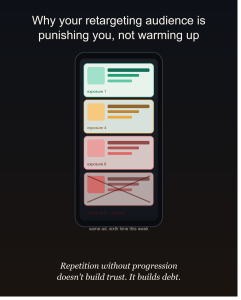
The retargeting sequence that turned toxic
Picture a mid-sized e-commerce brand selling skincare, running a standard cart-abandonment retargeting sequence. Someone adds a $68 serum to their cart, doesn’t check out, and enters the retargeting pool. Week one: a friendly reminder ad, product on a clean background, “still interested?” Reasonable. Week two: a slight variation, maybe a testimonial overlay. Still reasonable; engagement holds steady.
By week three, the same creative is still running, now shown for the sixth, seventh, eighth time to people who never converted. The frequency metric reads 6.2. On paper, that’s within normal range for a lot of retargeting benchmarks. But look at what’s actually happening to the person seeing it. They didn’t forget about the serum. They decided not to buy it, or they’re still on the fence, and now a brand they mildly liked two weeks ago is following them around asking the same question over and over with no new information, no new angle, nothing to actually move the decision forward.
By week four, click-through rate has dropped by more than half, but worse, the brand starts collecting something retargeting dashboards don’t measure: irritation. Some of those people will actively avoid the brand’s organic posts. Some will scroll past future ads faster out of habit. A few might even develop a mild negative association strong enough that when a friend asks about skincare, this brand doesn’t come to mind, or comes to mind with a slight “eh.” None of that shows up in Ads Manager. It shows up months later as a brand that inexplicably underperforms with an audience that technically saw it the most.
The mistake wasn’t running retargeting. It was mistaking repetition for progress. The ad never changed the terms of the decision. It just kept restating it.
The decision rule: track decay, not just frequency
Here’s the useful distinction. Frequency measures how often someone saw something. Decay measures whether the relationship with that content is getting weaker each time it repeats. You need both numbers, but decay is the one that tells you when to act.
A practical way to track this: watch engagement rate on the same creative exposure over exposure, not just in aggregate. If click-through rate on exposure four is noticeably lower than exposure one for the same segment, that’s decay. If it’s holding steady, you still have room. Most retargeting creative starts decaying somewhere between the third and fifth exposure, though the exact point depends on how emotionally loaded the offer is. A $12 impulse item can tolerate more repetition than a $500 considered purchase, because the considered purchase carries more unresolved tension per view.
The decision rule is simple to state and easy to apply: when engagement on a specific creative drops for two consecutive exposures within the same audience segment, retire or refresh it immediately; don’t wait for CPM to confirm what engagement already told you. Waiting for cost metrics to catch up means you’re spending to confirm a problem you could have already fixed.
Refreshing doesn’t mean changing the button color or swapping a product photo. It means changing what the ad is actually saying to the person. If the first three exposures asked “still thinking about it?”, the fourth needs to answer a real objection, address price, show a different use case, or introduce social proof that wasn’t there before. The goal is to give the viewer something new to resolve, not the same open loop wearing a different shirt.
Here’s the insight worth remembering and repeating: repetition without progression doesn’t build trust; it builds debt, and eventually the audience calls it in.
Once you see retargeting fatigue this way, a bigger question opens up. If the same principle applies to email sequences, retention content, and even organic posting frequency to a warm audience, the real skill isn’t building bigger retargeting pools. It’s learning to notice, segment by segment, exactly where recognition quietly turns into resentment before the numbers admit it.