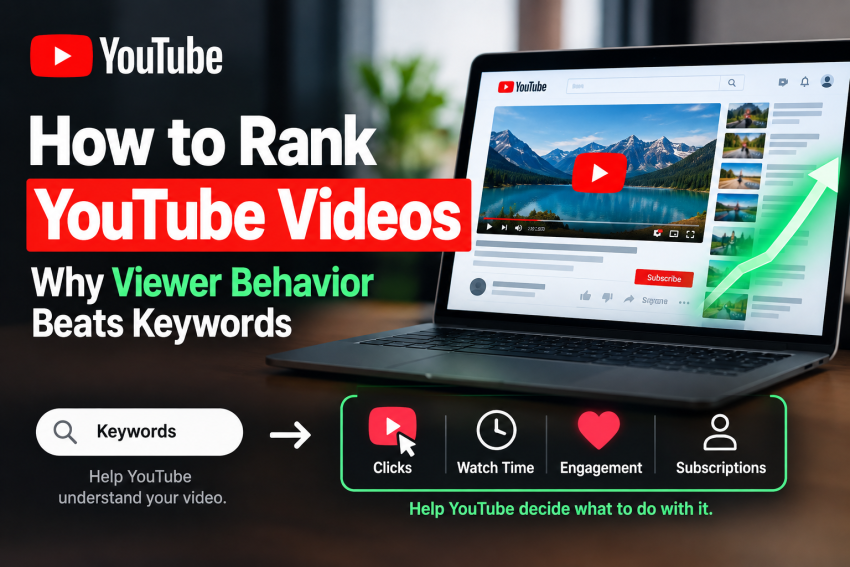
Most creators think ranking on YouTube starts with keywords.
It doesn’t.
Keywords can help YouTube understand what your video is about. But understanding the topic is only the beginning.
The bigger question is:
What happens after YouTube shows your video to people?
Do they click?
Do they keep watching?
Do they get what they expected?
Do they continue watching more videos?
Those signals tell YouTube whether your video deserves more distribution.
And this changes the entire way you should approach YouTube SEO.
Keywords Don’t Create Demand
Imagine two videos targeting the exact same keyword.
One has perfectly optimized tags, a keyword-rich description, and an accurate title.
The other has simpler metadata but a compelling title, strong thumbnail, and content that immediately delivers what viewers wanted.
If the second video consistently produces stronger viewer response, keyword optimization alone won’t save the first.
That’s because YouTube isn’t simply trying to identify videos.
It’s trying to connect viewers with videos they are likely to value.
This is the distinction many creators miss.
SEO helps YouTube understand your video. Viewer behavior helps YouTube decide what to do with it.
The Click Is Only the Beginning
A high click-through rate looks impressive.
But a click by itself doesn’t prove that a video is valuable.
Someone can click because the thumbnail is intriguing.
Then they can leave after 10 seconds.
That creates a problem.
The packaging generated interest, but the actual video failed to satisfy the expectation.
This is why your title and thumbnail shouldn’t simply create curiosity.
They need to create accurate curiosity.
The viewer should click because they believe your video contains something they genuinely want.
Then the opening needs to immediately reinforce that decision.
The First 30 Seconds Are a Test
The beginning of your video has one critical job:
Prove that the viewer made the right decision by clicking.
Don’t spend the opening minutes explaining who you are.
Don’t delay the answer.
Don’t repeat the title.
Don’t make viewers wait for the useful part.
Give them evidence that the promised value is coming.
This matters because attention is constantly being evaluated.
The brain is continually processing whether incoming information is relevant enough to continue consuming.
If the viewer expected a solution and instead receives a long introduction, their attention can decline quickly.
The result?
A viewer leaves.
And the algorithm receives another piece of evidence about how people respond to the video.
Relevance Creates Stronger Attention
This is where specificity becomes powerful.
Instead of trying to make a video appeal to everyone interested in “YouTube SEO,” identify exactly who needs the information.
For example:
Weak positioning:
“How to Rank YouTube Videos”
More specific positioning:
“How to Rank YouTube Videos When Your Channel Has Less Than 1,000 Subscribers”
The second version creates a stronger identification mechanism for the right viewer.
They can immediately recognize:
“This is for me.”
That reduces the mental effort required to decide whether the video is relevant.
The goal isn’t maximum clicks from everyone.
The goal is maximum satisfaction from the people most likely to value the video.
Your Thumbnail and Title Are Part of the Content
Creators often treat packaging as separate from the video.
That’s a mistake.
The title and thumbnail establish an expectation.
The video either confirms that expectation or violates it.
If your thumbnail promises one thing and the video delivers another, you create a disconnect.
That disconnect can damage viewer satisfaction even if the video itself contains useful information.
So think about your title, thumbnail, and opening as one system.
The title creates the expectation.
The thumbnail strengthens the expectation.
The opening confirms the expectation.
The rest of the video earns continued attention.
When those four elements agree, the viewer doesn’t have to reconsider the decision to keep watching.
Stop Chasing Watch Time Alone
Watch time matters.
But maximizing minutes isn’t the same as maximizing value.
A 20-minute video isn’t automatically better than a 7-minute video.
If the 7-minute video solves the viewer’s problem efficiently, forcing the topic into 20 minutes can actually make the experience worse.
The better objective is:
Make the viewer feel that watching was worth the time.
That can mean a short video.
It can mean a long video.
Length should follow the value required to satisfy the viewer, not the other way around.
The Real YouTube SEO Framework
Instead of starting with:
“What keyword should I target?”
Start with five questions:
1. Who is this video specifically for?
Define the viewer.
Not “people interested in YouTube.”
A much more precise audience might be:
“Small YouTube creators who publish consistently but aren’t getting search traffic.”
2. What problem are they trying to solve?
Identify the actual problem behind the search.
The keyword is only the surface expression.
3. What promise will make the right person click?
Your title and thumbnail should communicate a compelling reason to watch.
4. Can the opening immediately validate the click?
Deliver relevance quickly.
Don’t make viewers work to discover why they should stay.
5. Does the video actually satisfy the promise?
This is the part creators cannot fake indefinitely.
If the content doesn’t deliver, better packaging only creates more disappointed viewers.
The Biggest Reframe
YouTube SEO isn’t about manipulating an algorithm.
It’s about producing evidence that your video satisfies a particular audience.
That’s a completely different mindset.
Instead of asking:
“How do I make YouTube rank this video?”
Ask:
“How do I make the right viewer click, stay, get value, and want another video?”
That question leads to better titles.
Better thumbnails.
Better openings.
Better content.
And ultimately, a stronger channel.
Keywords still have a role.
But they are not the strategy.
They are part of the system that helps YouTube understand the video.
The real strategy is creating a video that viewers repeatedly prove they want to watch.
That is the shift from keyword optimization to audience optimization.
And once you make that shift, YouTube SEO becomes much easier to understand.